TL;DR: Root stress is a silent killer of landscape trees, often caused by invisible issues like soil compaction, deep planting, or improper watering. Because roots are hidden underground, symptoms often appear in the leaves or branches when damage is already advanced. Recognizing early signs—like early fall color or canopy dieback—and addressing the root cause can save your tree from decline.
Key Takeaways:
- Look Up to See Down: Symptoms of root stress often manifest in the canopy, including yellowing leaves, scorched edges, and dieback from the top down.
- Common Culprits: The most frequent causes are human-made: “mulch volcanoes,” planting too deep, and soil compaction from construction or foot traffic.
- Water Wisely: Overwatering is just as dangerous as drought. Roots need oxygen as much as they need water.
- Fixable Issues: Solutions range from simple mulching adjustments to professional air spading, but severe cases may require removal.
Table of Contents:
- What is Root Stress?
- How Can I Identify Root Stress?
- What Causes Root Stress?
- How Can I Fix Root Stress?
- Frequently Asked Questions
- Quick Recap
- Conclusion
Your trees are stoic giants. They weather storms, provide shade, and anchor your landscape. But beneath the surface, a delicate struggle might be taking place. While we often focus on the leaves and branches we can see, a tree’s health is dictated by the “hidden half” underground.
When roots can’t function properly, the entire tree suffers. This condition, known as root stress, acts like a slow-moving restriction on the tree’s lifeline. It cuts off the essential flow of water and nutrients, leaving the tree vulnerable to pests, diseases, and environmental shifts. Unfortunately, because the problem lies buried in the soil, many homeowners don’t notice something is wrong until the damage is severe.
Understanding the subtle signals your tree sends is the first step in restoring its vitality. By learning to read the leaves and inspect the trunk, you can uncover what is happening below ground and take action before it’s too late.
What is Root Stress?
Root stress is a broad term for any condition that inhibits a tree’s root system from growing, absorbing water, or taking in oxygen.
Think of roots as the engine of the tree. If the engine is choked or starved of fuel, the car won’t run, no matter how shiny the paint is. Healthy roots require a balance of four things: water, nutrients, physical space to grow, and—crucially—oxygen.
When soil conditions prevent roots from accessing these essentials, the tree enters a state of physiological stress. This weakens the tree’s natural defenses, making it an easy target for secondary invaders like borers or fungal diseases.
How Can I Identify Root Stress?
Since you can’t easily dig up a mature tree to check its roots, you have to look for clues above ground. The canopy acts as a mirror for the root system; if the roots are unhappy, the leaves will tell you.
Watch for these common symptoms:
- Canopy Dieback: This is often the most alarming sign. You might notice dead branches at the very top of the tree or on the outer tips. This happens because the struggling root system can no longer pump water and nutrients to the furthest points of the tree.
- Leaf Scorch: If the edges of the leaves look brown, crispy, or “burnt,” especially during summer, it usually means the roots aren’t supplying enough water to keep up with evaporation.
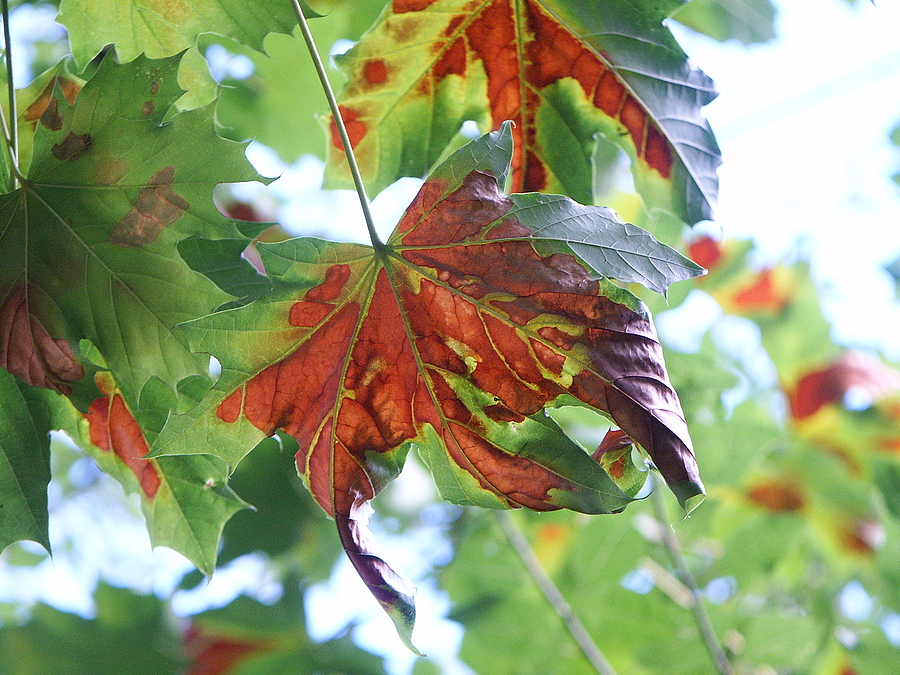
- Chlorosis (Yellowing): When roots are suffocated by compacted or wet soil, they cannot absorb nutrients like iron or manganese. This results in leaves that are pale green or yellow while the veins remain green.
- Early Fall Color: If your maple turns red in August while the neighbors’ trees are still green, it isn’t just eager for autumn. Premature color change is a classic distress signal.
- Suckers and Water Sprouts: A stressed tree often tries to save itself by growing new shoots rapidly from the base of the trunk (suckers) or along the main branches (water sprouts).
- Visible Root Issues: Look at the base of the trunk. If you see roots wrapping tightly around the trunk (girdling roots) or if the trunk looks like a telephone pole going straight into the ground with no flare, the roots are likely in trouble.
What Causes Root Stress?
Most root stress is abiotic, meaning it is caused by non-living environmental factors rather than pests or bacteria. Surprisingly, many of these issues are human-made.
Is your soil compacted?
Healthy soil is about 50% pore space—tiny pockets filled with air and water. When heavy machinery, cars, or even constant foot traffic compress the soil, those pockets are crushed. This is called soil compaction.
- The result: Roots suffocate because they lack oxygen. Water runs off the surface instead of soaking in, leading to drought stress even when it rains.
Are you “killing with kindness” (Mulch Volcanoes)?
One of the most common landscape crimes is the “mulch volcano”—piling mulch high against the tree trunk.
- The result: Tree bark is meant to be dry, not wet. Piling mulch against it causes the bark to rot and encourages roots to grow into the mulch rather than the soil. It can also suffocate the buried roots below.
Was the tree planted too deep?
If a tree is planted too deep, the root flare (the wide part where trunk meets roots) is buried.
- The result: This suffocates the phloem cells at the base of the trunk and can lead to girdling roots—roots that grow in a circle and eventually strangle the tree.
Is the drainage poor?
Trees need water, but they don’t want wet feet. If water sits in the planting hole because of heavy clay soil or overwatering, the oxygen in the soil is replaced by water.
- The result: Root rot. The roots literally decay and die, preventing them from absorbing the very water they are drowning in.
How Can I Fix Root Stress?
If you catch it early, root stress can often be managed or reversed. The goal is to improve the soil environment so new roots can grow.
1. Correct Your Mulching
If your tree looks like it’s erupting from a mountain of mulch, fix it immediately.
- The fix: Pull the mulch back from the trunk. You should be able to see the root flare. Spread the mulch in a “donut” shape, 2 to 4 inches deep, extending as far out to the drip line (the edge of the branches) as possible. This mimics the forest floor, keeping soil cool and moist without suffocating the trunk.
2. Alleviate Compaction
For compacted soil, you need to reintroduce air.
- The fix: Vertical mulching or core aeration can help. For severe cases, professional arborists use an “air spade”—a tool that uses compressed air to blast apart compacted soil without damaging roots. They then mix in organic matter to keep the soil loose.
3. Water Deeply and Infrequently
Stop sprinkling your trees every day for 10 minutes. This encourages shallow, weak roots.
- The fix: Water deeply so the moisture penetrates 6 to 9 inches down. Then, let the soil dry out slightly before watering again. This encourages roots to grow deep to find water, making the tree more resilient.
4. Excavate the Root Collar
If your tree looks like a telephone pole (no flare visible at the bottom), it is buried too deep.
- The fix: Carefully remove the soil and mulch from around the base of the trunk until you find the first main structural roots. If you find small roots wrapping around the trunk (girdling roots), they may need to be carefully cut. Note: For large trees, this is a delicate task best left to professionals.
Frequently Asked Questions
Can a tree recover from root stress?
Yes, often trees can recover if the stress is identified early. However, recovery is slow. Trees grow on a different timeline than flowers or vegetables. It may take a year or two of proper care (mulching, watering, soil correction) before you see significant canopy improvement.
How do I know if it’s root rot or drought?
Ironically, the symptoms look the same: yellowing leaves and wilting. The difference is in the soil. Dig a small hole 6 inches deep near the tree. If the soil is sopping wet and smells like rotten eggs, it’s root rot/overwatering. If it’s bone dry and hard, it’s drought.
Is hammering spikes into the soil good for aeration?
Generally, no. Simply punching holes with a spike compresses the soil around the hole, making compaction worse in those areas. Removing soil cores (plugs) or using air tools is much more effective.
Quick Recap
- Roots need air: Compacted soil kills roots by suffocating them.
- Watch the leaves: Top-down dieback and early color changes are SOS signals.
- Mulch correctly: Keep it off the trunk (donut shape), not piled high (volcano).
- Check the flare: You should see the trunk widen at the base. If not, excavate.
- Water deep: Soak the root zone, then let it breathe.
In Summary
Trees are valuable assets that increase property value and quality of life. While they are incredibly resilient, they have their limits. By paying attention to the soil beneath them and avoiding common pitfalls like over-mulching or deep planting, you can help your trees thrive for decades.
However, sometimes damage to the root system is too extensive to reverse. If your tree shows severe dieback, lean, or signs of instability, it may pose a safety risk to your home and family.
Need help with a struggling tree? If your tree is beyond saving or poses a danger to your property, don’t wait for a storm to bring it down. Contact Us Today for a Professional Tree Removal Service in Indianapolis. Our experts can assess the health of your trees and safely remove those that are no longer viable.
Related Post: Spotting the Symptoms: How to Tell If Your Tree Is Sick